Thursday, 10 December 2015

Research: Blocking a Scene
Every film shoot is divided into five parts:
1. Block – determining where the actors will be on the set and the first camera position
2. Light – time for the DOP to light the set and position the camera for the first shot
3. Rehearse – camera rehearsal of the first set-up with the actors and crew
4. Adjustments – making lighting and other adjustments
5. Shoot – shooting the first scene (then repeat the process)
Put into simple terms, block a scene is “working out the details of an actor’s moves in relation to the camera.” Through blocking the scene you are ensuring that every element (actors, extras, crew) move harmoniously together to ensure that a scene runs smoothly. Shot lists are often used for this purpose in order to make sure a path is set for the people on set as to where they need to go. This is all done to ensure that the scenes are performed correctly and play out exactly how the director wants them to.
Wednesday, 9 December 2015
Inspiration
Perks of Being a Wallflower (2012):
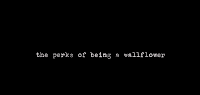 At the beginning of my research I analysed the opening for this film, and have taken on board certain elements as inspiration for my own production. Firstly, I liked the idea of a false sense of security at the start of the film as the audience believes that everything is fine when in actuality it is not. I also enjoyed the simplistic typewriter style font and sound effects used for the opening titles. I feel that this adds to the theme of nostalgia as the font appears old and out of date, therefore it may be something that we use in our own production as we are following a similar theme.
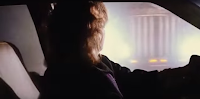
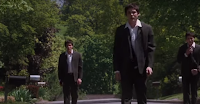 There is also a scene later in the film that deeply influenced my own film ideas. In this sequence Charlie, the film's protagonist, begins to deteriorate mentally. This scene delivers high emotional impact through its use of flashbacks and confusing sequences. A medium long shot shows Charlie walking up the street in an exhausted manner. Flashes of memories appear throughout this shot, revealing new information about the character's past. After each flashback, we are referred back to the same shot, however Charlie has been multiplied. This
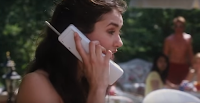 continues until there are three versions of Charlie walking up the street. This clearly shows his fragile state of mind as the memories confuse and distort his version of reality. This is very similar to what we hope to represent in our own film and has highly influenced the way in which we will be representing the deterioration of our main protagonist.
 Also in these scenes, there is a very limited amount of dialogue. When Charlie does speak, it is on the phone to his sister, however he is not on screen during this time. His voice sounds broken, scared and distant and worries the audience as they can not see his physical state thus leading them into fearing the worst for this character as we do not know what he is doing or where he is. Further shots of an empty room again reinforce this feeling within the audience. This reaction of confusion and fear towards the character is something that we would like to be able to stir within our own audience.
Sources: > https://www.youtube.com/watch?v=c9OVBkRPEh0
>https://www.youtube.com/watch?v=BQPhbA1luzw
Teen Wolf - TV Show
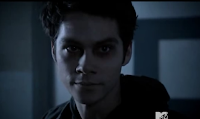 One of the protagonists of this programme, Stiles, experiences a subconscious battle within himself. His demeanor becomes extremely aggressive as he looses who he truly is. We took inspiration from this as his character transforms from a relatable young teenager to someone frightening and unrecognisable, which is extremely similar to our own story. We shall direct the actor playing our main protagonist in a similar way as we would like to achieve a similar sense of pity and fear as is created in this show.
We have also taken inspiration from the visual effects used in this show. Firstly, the makeup used in
these scenes makes the character appear vacant and tired. It enhances the fear factor created within the audience and therefore allows the scenes to land much greater impact. The scenes with the character also have very dim and dreary lighting again adding to the overall tone of the scene. This is something that we also be doing in our own production.
Sources: > https://www.youtube.com/watch?v=_QJ-534nAy4
> https://www.youtube.com/watch?v=Rg3qMmPJKJA
Up (2009)
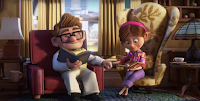
 This film opens with a montage of memories leading up to the present. They begin with joyous events from the beginning of Ellie and Carl's relationship, however as time goes on the scenes depicted are much sadder; first as they find out that they will never have children and later leading up to Ellie's illness and eventual death, leaving Carl all alone. The music played over the top of these
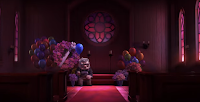 images shifts in tone along with the scenes, adding to the deeply saddening ending of the montage, and thus delivering a much stronger impact on the audience. In the final scene we see Carl sat alone for the first time, holding a single ballon.
Loneliness is a key theme in this film as well as in my own. For our production we would also like to combine memories to create a similar sort of timeline of events. I also have found from this film that by having the protagonist sat alone, sympathy is created for that character is created early on. We will therefore be using this in our own film however we will distort the idea in order to fit in with the genre of thriller, by having our character look scary on top of being desperate and alone. We will also be including a similar shift in the music from cheerful and merry to sad and tense.
Source: https://www.youtube.com/watch?v=F2bk_9T482g
500 Days of Summer (2009)
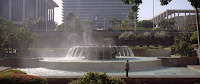
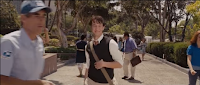
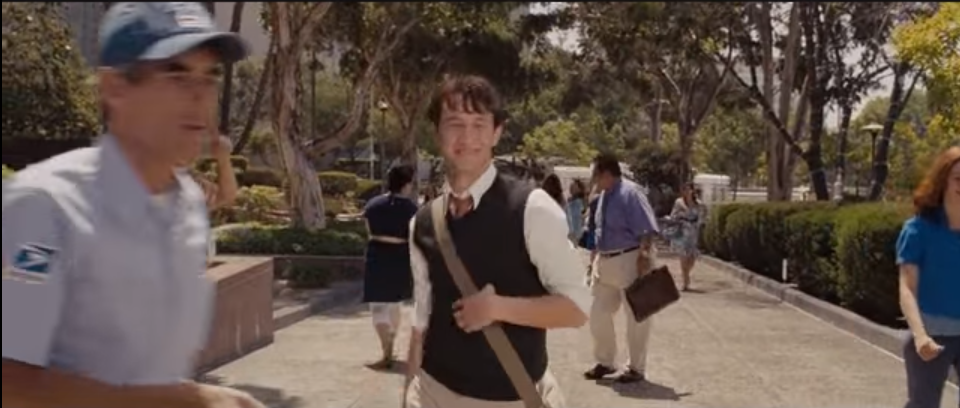
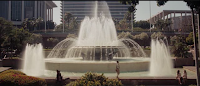 This film follows the protagonist, Tom, in his pursuit of love. We watch his relationship with Summer through a distorted non-linear timeline, hopping between past and present. In this film some scenes are repeated. For example, after spending their first night together Tom is elated and dances through the streets with joy. However later in the film, when their relationship begins to fall, we see Tom take the same path to work, but the tone has changed completely. Instead of dancing he drags his feet, and instead of water fountain displays lighting up in his presence, they fall down. This shift in tone is something we would like to be able to achieve in our own film. Through repeating the sequence the change in mood is much more apparent and therefore has a greater impact on the audience. Therefore we will consider repeating locations for our flashbacks in order to create a similar effect to this.

Sources: > https://www.youtube.com/watch?v=8tJoIaXZ0rw
> https://www.youtube.com/watch?v=ctF7IkKNQ4U
 At the beginning of my research I analysed the opening for this film, and have taken on board certain elements as inspiration for my own production. Firstly, I liked the idea of a false sense of security at the start of the film as the audience believes that everything is fine when in actuality it is not. I also enjoyed the simplistic typewriter style font and sound effects used for the opening titles. I feel that this adds to the theme of nostalgia as the font appears old and out of date, therefore it may be something that we use in our own production as we are following a similar theme.
 There is also a scene later in the film that deeply influenced my own film ideas. In this sequence Charlie, the film's protagonist, begins to deteriorate mentally. This scene delivers high emotional impact through its use of flashbacks and confusing sequences. A medium long shot shows Charlie walking up the street in an exhausted manner. Flashes of memories appear throughout this shot, revealing new information about the character's past. After each flashback, we are referred back to the same shot, however Charlie has been multiplied. This
  continues until there are three versions of Charlie walking up the street. This clearly shows his fragile state of mind as the memories confuse and distort his version of reality. This is very similar to what we hope to represent in our own film and has highly influenced the way in which we will be representing the deterioration of our main protagonist.
 Also in these scenes, there is a very limited amount of dialogue. When Charlie does speak, it is on the phone to his sister, however he is not on screen during this time. His voice sounds broken, scared and distant and worries the audience as they can not see his physical state thus leading them into fearing the worst for this character as we do not know what he is doing or where he is. Further shots of an empty room again reinforce this feeling within the audience. This reaction of confusion and fear towards the character is something that we would like to be able to stir within our own audience.
Sources: > https://www.youtube.com/watch?v=c9OVBkRPEh0
>https://www.youtube.com/watch?v=BQPhbA1luzw
Teen Wolf - TV Show
 One of the protagonists of this programme, Stiles, experiences a subconscious battle within himself. His demeanor becomes extremely aggressive as he looses who he truly is. We took inspiration from this as his character transforms from a relatable young teenager to someone frightening and unrecognisable, which is extremely similar to our own story. We shall direct the actor playing our main protagonist in a similar way as we would like to achieve a similar sense of pity and fear as is created in this show.
We have also taken inspiration from the visual effects used in this show. Firstly, the makeup used in
these scenes makes the character appear vacant and tired. It enhances the fear factor created within the audience and therefore allows the scenes to land much greater impact. The scenes with the character also have very dim and dreary lighting again adding to the overall tone of the scene. This is something that we also be doing in our own production.
Sources: > https://www.youtube.com/watch?v=_QJ-534nAy4
> https://www.youtube.com/watch?v=Rg3qMmPJKJA
Up (2009)

 This film opens with a montage of memories leading up to the present. They begin with joyous events from the beginning of Ellie and Carl's relationship, however as time goes on the scenes depicted are much sadder; first as they find out that they will never have children and later leading up to Ellie's illness and eventual death, leaving Carl all alone. The music played over the top of these
 images shifts in tone along with the scenes, adding to the deeply saddening ending of the montage, and thus delivering a much stronger impact on the audience. In the final scene we see Carl sat alone for the first time, holding a single ballon.
Loneliness is a key theme in this film as well as in my own. For our production we would also like to combine memories to create a similar sort of timeline of events. I also have found from this film that by having the protagonist sat alone, sympathy is created for that character is created early on. We will therefore be using this in our own film however we will distort the idea in order to fit in with the genre of thriller, by having our character look scary on top of being desperate and alone. We will also be including a similar shift in the music from cheerful and merry to sad and tense.
Source: https://www.youtube.com/watch?v=F2bk_9T482g

500 Days of Summer (2009)
 This film follows the protagonist, Tom, in his pursuit of love. We watch his relationship with Summer through a distorted non-linear timeline, hopping between past and present. In this film some scenes are repeated. For example, after spending their first night together Tom is elated and dances through the streets with joy. However later in the film, when their relationship begins to fall, we see Tom take the same path to work, but the tone has changed completely. Instead of dancing he drags his feet, and instead of water fountain displays lighting up in his presence, they fall down. This shift in tone is something we would like to be able to achieve in our own film. Through repeating the sequence the change in mood is much more apparent and therefore has a greater impact on the audience. Therefore we will consider repeating locations for our flashbacks in order to create a similar effect to this.
Sources: > https://www.youtube.com/watch?v=8tJoIaXZ0rw
> https://www.youtube.com/watch?v=ctF7IkKNQ4U
Monday, 7 December 2015
Initial Narrative Ideas and Mood Board
Psychological thrillers can be differentiated from ordinary thrillers by the heavy focus that they hold on the unstable emotions of the characters in the film. These type of thrillers still incorporate the common elements of mystery and drama, but the emotional status is usually the main focus. In these films it is often the case that the protagonist is battling their own mind, so therefore, these movies often follow a first person narrative, in which the plot follows only one or two characters. This allows a rapport to be established between the character and the audience and allows the audience to better understand the protagonist's mind, as it is a key element in these types of films.
Typically, the key elements of psychological thrillers are:
Typically, the key elements of psychological thrillers are:
- Reality
- Perception
- Mind
- Identity
- Death
- Mystery
Psychological thrillers also often begin with a back story in which the history of the plot is established. This is done to deepen the psychological aspect of the story as the viewer is able to understand the character better and therefore will be more interested in their recovery/ how they will escape their current mental trauma.
Our thriller opening consists of the the main character (character 1) slowly deteriorating from a happy, relatable young girl to a scared, vacant shadow of a person. We follow her and her best friend first through fond, treasured recollections and then later through horrid tormenting memories. In one of the later, darker flashbacks Character 1 shouts out for her friend to 'get out of my head!', conforming to the traditional narrative of this genre as the audience questions the mental state of this girl and perhaps whether her friend is truly there or not. Confusing sequences will also be used, in which the second character flashes in and out of the scene, again allowing the audience to question the existence of this character.
This mood board visually represents some of the narrative ideas that I have had for my own production.
 As shown above, the mood board images incorporate both pictures of desperation and sadness but also happy, fond memories between close friends. These pictures represent the journey of the characters as they transition from the calm and pleasant images to the more tragic and scary pictures.
The story will follow a non-linear narrative as the opening of the film will be mixture of both present and past. With the use of this particular narrative structure the story will become distorted and confusing for the audience which will allow us to create enigma and conform to 'mystery' element of a typical thriller film. This also conforms to Barthes' enigma code, as it will keep the viewer guessing as to what will happen next.
Our opening story will also follow an open narrative in which there is no clear resolution made at the end. This is more appropriate for our task of creating an opening for a film as it keeps the viewer interested for the following story. This means that our opening does not follow any of the typical forms of narrative. For example, in Todorov's theory there is a resolution following the disruption, the disruption in this case being the mental breakdown of our main protagonist. However, in our story, this issue is never resolved nor is the full story ever revealed, therefore making room for questions and interpretation from the audience, enticing them and making them want to watch on.
This mood board visually represents some of the narrative ideas that I have had for my own production.

The story will follow a non-linear narrative as the opening of the film will be mixture of both present and past. With the use of this particular narrative structure the story will become distorted and confusing for the audience which will allow us to create enigma and conform to 'mystery' element of a typical thriller film. This also conforms to Barthes' enigma code, as it will keep the viewer guessing as to what will happen next.
Our opening story will also follow an open narrative in which there is no clear resolution made at the end. This is more appropriate for our task of creating an opening for a film as it keeps the viewer interested for the following story. This means that our opening does not follow any of the typical forms of narrative. For example, in Todorov's theory there is a resolution following the disruption, the disruption in this case being the mental breakdown of our main protagonist. However, in our story, this issue is never resolved nor is the full story ever revealed, therefore making room for questions and interpretation from the audience, enticing them and making them want to watch on.
Final Sub-genre Decision
After researching the elements that make up thriller and its many sub-genres we came to the conclusion that our production will be a psychological thriller. This is most likely the best fit for the plot line in which our film is going to follow, as we visually see the deterioration of the main character in the opening.
Psychological thrillers often follow the themes of:
This mood board presents some of the visual elements typically associated with the psychological thriller genre.
 From these images it is clear that we will have to incorporate dark mood lighting and disturbing makeup into our final production in order to make it conform to the typical conventions of a psychological thriller. We may also have to use a sharp, harsh font for our film title, as seen in the 'Orphan' poster, in order to make this easily identifiable as a thriller film.
I have also taken my previous film opening analysis's into consideration. For example, I reviewed the film Limitless which would fall into the psychological thriller sub-genre as it deals with both death, and perception and reality within the protagonist's mind. I would like to use similar moody lighting and varying speeds in camera movements. I also like the idea of the simple credits and
Psychological thrillers often follow the themes of:
- Death
- Perception
- Existence/ purpose
- identity
- Reality
This mood board presents some of the visual elements typically associated with the psychological thriller genre.

I have also taken my previous film opening analysis's into consideration. For example, I reviewed the film Limitless which would fall into the psychological thriller sub-genre as it deals with both death, and perception and reality within the protagonist's mind. I would like to use similar moody lighting and varying speeds in camera movements. I also like the idea of the simple credits and
Monday, 9 November 2015
Sunday, 8 November 2015
The Task
For this project we were asked to produce:
- A film opening that conforms to the conventions of the thriller genre - with a sub-genre of your choice. It also must be between two and two and half minutes in length.
Subscribe to:
Comments (Atom)